Earn to Die Rogue
- 4.5
- Rating
- 10.00M
- Installs
- Free
- Price

 Analysis by App-foxy
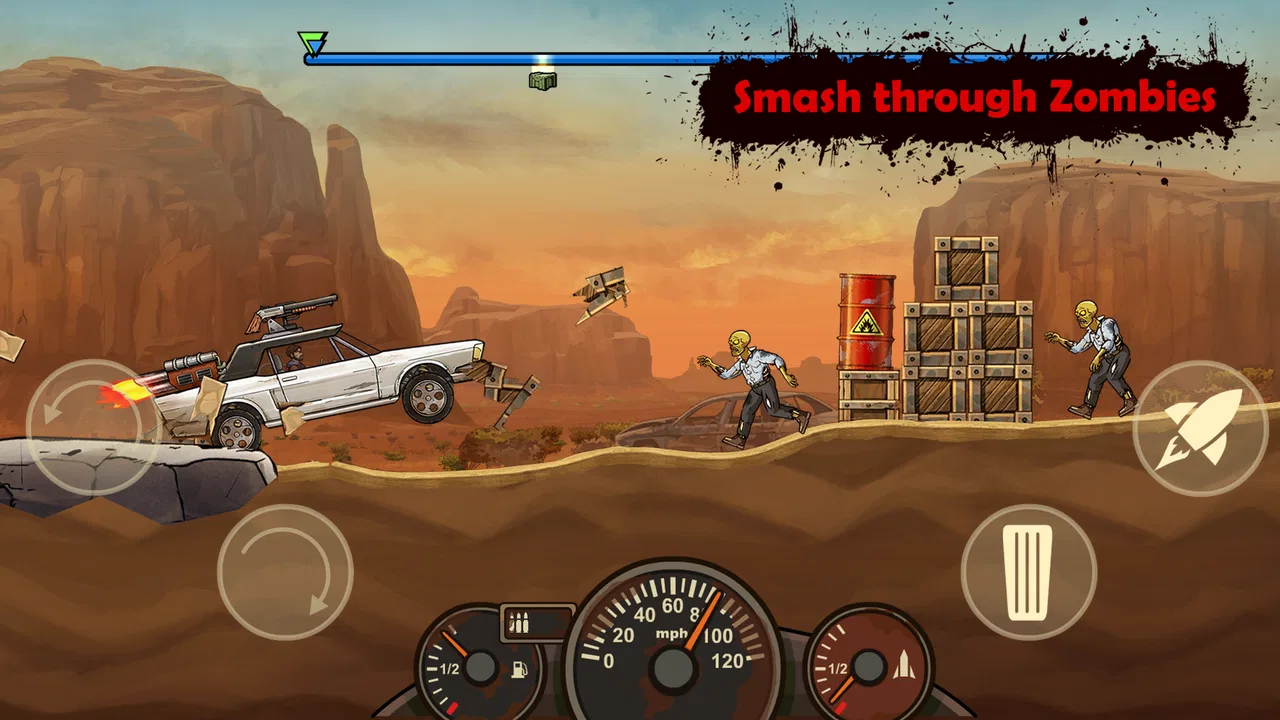
Earn to Die Rogue takes the familiar zombie-driving idea and pushes it toward a more active, run-based style of racing. I spend my time steering through infected areas, smashing through crowds, entering buildings for loot, and trying to turn each attempt into enough progress for the next challenge. It is free to play, but it also includes optional purchases ranging from $0.99 to $99.99 per item, so the real question is not whether it is easy to start, but whether its rhythm keeps you interested after the first burst of excitement.
My first impression was that this is less about simply reaching the finish line and more about making useful decisions while everything is falling apart around me. The car is important, but so is knowing when to push forward, when to take a safer route, and when a building or detour is worth the risk. That gives the game a more deliberate feel than a basic endless driving title.
How the driving, loot, and early goals work together
The early goals are easy to understand without being completely empty. I want to survive the current stretch, clear the zombies blocking my path, and search infested buildings for loot that can help me continue. That creates a simple loop: drive, fight through resistance, collect what I can, and use the result of the run to prepare for another attempt.
You May Also Like

 Blood Strike: 2.5 Anniversary
Blood Strike’s Loadouts Turn Every Drop Into a Tactical Gamble
A close look at Blood Strike’s custom loadouts: how fast access to signature weapons reshapes its battle royale rhythm, rewards preparation, and narrows the gap between fights.

 Pandora - Music & Podcasts
Pandora’s Music Is Easy to Start, but Harder to Recover
Pandora’s strength is its low-effort path from a seed to a station. Its weak spot is how much confidence it asks you to place in connection, setup, and quiet recovery.

 8 Ball Pool
 Is Built on Rivalries, Rematches, and Routine
A close look at the rivalries, rematches, shared routines, and unanswered safety questions that turn a quick pool match into a persistent mobile community.

 Samsung Music
’s Quiet Strength Is Playing What You Already Own
Its reach comes less from spectacle than from dependable access to a personal library. That simplicity is both the app’s strongest retention engine and its ceiling.

 AccuWeather: Weather Radar
AccuWeather Review: A Quick, Clear Forecast for Everyday Decisions
For everyday plans, the best forecast is the one you can understand quickly. AccuWeather makes rain timing, radar, and local conditions easy to act on, with a few trade-offs.

 Hill Climb Racing
Why Hill Climb Racing Still Turns Crashes Into One More Run
A tiny car, a bumpy hill and one more upgrade: Hill Climb Racing keeps resurfacing because its simple chaos makes every near-miss feel personal.
More From Our News Desk



What makes this opening work is the way each objective supports the next one. Driving only for distance can leave useful rewards behind, while stopping to explore everything can expose me to more danger. I quickly found myself asking whether a building was worth entering or whether staying on the road would give me a better chance of finishing the section. Those small choices make the opening feel more involved than a straight acceleration test.
The controls are at their best when I treat the vehicle as a tool rather than an unstoppable weapon. A crowded road can drain momentum, and a poorly timed push into a zombie group may leave the car in a worse position than before. I had to learn to read the space ahead instead of reacting only after the car was already surrounded.
That is also where the game’s racing identity becomes clear. This is not a conventional circuit racer built around clean corners, lap times, and opponents following the same track. Its competition is the environment itself: the horde, the damaged route, the buildings, and the pressure to get more from each run. Players looking for traditional racing lines or head-to-head events may find the format unusual.
The scavenging side gives the early minutes a useful purpose. Loot is not just decoration placed along the route; it gives me a reason to explore and to accept calculated risks. A cautious player can focus on survival, while a more ambitious player can chase extra rewards and accept that some runs will end badly. That difference in attitude helps the game accommodate short sessions without making every attempt feel identical.
One practical tip is to avoid treating every visible reward as mandatory. When the car is already struggling or the route is packed with zombies, forcing a detour can waste a promising run. I get better results by deciding what the run is supposed to accomplish before I commit: safe progress, exploration, or a more aggressive attempt at collecting loot.
Progress feels clearest when I set one purpose per run
The strongest progress signal is not a single dramatic victory screen. It is the gradual sense that a route that previously stopped me is becoming manageable. I notice it when I reach a building that used to be too dangerous, survive a thicker group of zombies, or finish with enough confidence to take a risk that was impossible earlier.
That kind of progress suits the game’s structure because every run can teach me something even when it does not end well. I learn which stretches punish hesitation, which choices are too greedy, and how much room I need before making a push. The result is a game that rewards observation as much as reflexes.
The unlock-and-upgrade feeling is most satisfying when it changes what I can attempt rather than merely making the numbers look larger. A stronger vehicle or better preparation matters because it turns previously frustrating sections into realistic targets. I prefer that kind of progression to a system where I am only collecting rewards without changing my approach.
At the same time, the game can make progress feel uneven if I enter a run without a clear plan. Chasing every reward may produce a busy session but not necessarily a useful one. I recommend alternating between focused attempts aimed at advancing and exploratory attempts aimed at learning the layout and testing the limits of the car. That simple habit makes the progression feel less random.
There is also a useful distinction between progress and success. A failed run can still be worthwhile if it reveals that I am taking a route too early or spending too much time in a dangerous area. Players who need every attempt to end with a visible reward may find the loop less satisfying, while players who enjoy gradually solving a hostile route will probably appreciate it.
The challenge curve rewards patience, but not endless caution
The difficulty works because the game repeatedly asks me to balance momentum against control. Moving too slowly can leave me surrounded, yet rushing forward without reading the terrain can create the same result. The best attempts come from keeping enough speed to stay active while avoiding reckless collisions.
Early sections give me room to understand that balance. Later situations feel more demanding because the margin for a poor decision becomes smaller. I cannot rely on one tactic forever, and a strategy that works on an open road may fail once buildings, tighter spaces, or heavier zombie pressure enter the picture.
That curve is more interesting than simply increasing enemy strength. The challenge comes from combining familiar problems in less forgiving ways. I may have enough power to break through a group, but not enough control to recover if I hit it at the wrong angle. I may have a clear route forward, but the most useful loot may sit somewhere that forces me to expose the vehicle.
My advice is to treat failed attempts as route practice rather than immediately spending resources to brute-force the problem. Watch where momentum disappears, notice which obstacles cause the car to stall, and identify the point at which exploration stops being sensible. This approach saves frustration and makes the eventual breakthrough feel earned.
There is a trade-off here. Players who enjoy carefully testing a system will find the difficulty motivating, but anyone wanting a relaxed zombie game may feel that the pressure arrives quickly. It is not the right choice if I want to cruise through a story with little resistance. The game expects me to pay attention, and that expectation remains part of its appeal.
Another useful habit is to separate mechanical mistakes from equipment limitations. If I repeatedly fail because I enter a crowded area at the wrong speed, more power may not solve the problem. If I am making the correct choices but still cannot clear a section, then progression becomes the sensible answer. Recognizing that difference prevents me from blaming the upgrade path for a mistake in timing.
Where the pacing stays engaging and where it can feel pressuring
The pacing is built around repeated attempts rather than long, uninterrupted races. That makes Earn to Die Rogue convenient for short breaks. I can play a run, learn something, and put the game down without needing a large block of time to appreciate what happened.
The same structure can create retention pressure. Because each attempt offers another chance to improve, it is easy to tell myself that one more run will finally work. That feeling is useful when I am genuinely learning, but less useful when I am repeating the same mistake or chasing loot without a clear purpose.
The free entry point lowers the barrier to trying it, while the in-app purchase range means players should decide early how they want to approach progression. I personally get more enjoyment when I treat purchases as optional rather than as part of the basic rhythm. The game is better suited to someone comfortable with gradual improvement than to someone who expects every obstacle to disappear immediately.
That does not make the monetization automatically a deal-breaker, but it does affect who should install it. If I dislike any temptation to speed up progress, I would rather choose a premium racing game with a simpler payment model. If I am happy to play for free and accept that progress may require patience, the starting experience is much easier to recommend.
The pacing also depends on how much variety I want from a racing game. This is a focused zombie-survival driving experience, not a broad collection of race types. Its appeal comes from improving runs, handling danger, and finding better ways through hostile areas. Someone looking for licensed cars, realistic racing, or multiplayer competition should look elsewhere.
For an everyday scenario, I can imagine playing it during a commute break or while waiting for an appointment. I would begin with a safe run to regain my sense of the route, then use a second attempt to test a risky building or chase extra loot. That two-step approach works well because it turns a few spare minutes into a small objective instead of an unfocused session.
Who will enjoy this particular progression loop
I recommend it most to players who like action games with visible improvement but do not need a traditional campaign structure. The combination of driving, zombie crowds, building exploration, and repeated attempts gives each session a clear identity. It is especially appealing if I enjoy learning through failure and making small changes to my approach.
It is also a good fit for fans of arcade racing who want more than steering around a track. The vehicle is still central, but the game adds survival decisions and scavenging pressure. I am not only asking how fast I can go; I am asking whether speed, caution, or exploration will produce the better result on this attempt.
I would be more hesitant to recommend it to someone who wants a calm game, a deep simulation, or a purely competitive race. The zombie setting is not just visual decoration. It shapes the entire challenge, and the constant threat of getting stalled or overwhelmed can make a casual session surprisingly tense.
It is also worth considering the age label. The game is rated Teen, which matches the violent zombie theme and the action-focused presentation. Parents choosing games for younger children should pay attention to that rating rather than assuming that a cartoon-like driving style makes the content suitable for everyone.
On the technical side, the game supports devices running Android 7.0 or later. The current version is 1.21.227, so players using older phones should check compatibility before planning around it. I would also keep some storage and battery awareness in mind for longer sessions, since repeated driving attempts can encourage me to play for longer than expected.
How it compares with ordinary racing alternatives
Compared with a standard arcade racer, this game gives me more reasons to slow down and think. Conventional racing usually rewards the cleanest line and the fastest lap, while this experience rewards survival, route judgment, and the value of what I collect along the way. It feels closer to a driving challenge wrapped around scavenging than to a traditional race.
Compared with an endless runner, it offers more deliberate decision-making. I am not simply reacting to obstacles appearing in front of me. The presence of buildings and loot makes me consider whether to leave the safest path, and the car’s condition or momentum makes each choice matter beyond the next few seconds.
Compared with a purely combat-focused zombie game, the vehicle changes the scale of the action. I am managing movement and positioning rather than standing in one place and clearing waves. That makes the game a better choice for someone who wants zombie pressure without giving up the satisfaction of driving through a dangerous environment.
The trade-off is specialization. A conventional racer may offer more track variety, while a zombie shooter may offer deeper combat. Earn to Die Rogue sits between those ideas and succeeds when I want its specific blend. It should not be installed as a substitute for every racing or zombie game; it should be chosen because this hybrid sounds appealing.
My verdict on goals, unlocks, and long-term pacing
Not Doppler has built a game whose strongest feature is the connection between its goals and its obstacles. Driving through zombie hordes, checking dangerous buildings, and improving future attempts all feed into the same loop. I rarely feel that the racing and scavenging elements are unrelated activities.
The progression is most convincing when I use it to solve a problem I understand. A new improvement feels meaningful after I have identified why a route is defeating me. It feels less satisfying when I pursue rewards automatically, so the game benefits from a thoughtful play style rather than constant rushing.
Its retention comes from the promise that the next run can be better, but that promise has limits. If I enjoy repeating sections to refine timing and route choices, the pacing can carry me for a long time. If I need frequent new modes or a constantly changing structure, the focused loop may begin to feel repetitive.
The game’s reception suggests that many players connect with this formula: it holds an average rating of 4.5 from around 94 thousand ratings, and it has passed 10 million installs. Those figures do not replace personal taste, but they do show that the combination of zombie action and driving has found a substantial audience.
As a free racing game, Earn to Die Rogue is worth trying if I want short, tense sessions built around gradual improvement. I would keep my expectations clear: this is not a realistic racer, not a relaxed driving game, and not the best option for anyone who dislikes repeated attempts or optional purchase pressure.
For me, the final recommendation is positive with conditions. The early goals are clear, the progress signals are easy to feel, and the difficulty gives successful runs real weight. I would install it when I want a focused arcade challenge and skip it when I am looking for broad racing variety. The best way to play is to give each run a purpose, resist chasing every reward, and let careful route learning do as much work as upgrades.
If that sounds like your kind of session, Earn to Die Rogue offers a distinctive alternative to ordinary mobile racing. It turns every drive into a small survival problem, and that is exactly why its simple premise remains engaging after the first few runs.
FAQs for Earn to Die Rogue
01What is the primary objective of Earn to Die Rogue?
In Earn to Die Rogue, the main goal is to navigate through a post-apocalyptic world filled with zombies using a variety of vehicles. Players must upgrade their vehicles with different parts and weapons to overcome obstacles and destroy zombies, allowing them to reach their destination safely. It's a thrilling mix of strategy and action.
02How does the vehicle upgrade system work in Earn to Die Rogue?
The upgrade system in Earn to Die Rogue allows players to enhance their vehicles with various parts such as engines, wheels, and weapons. These upgrades are essential for progressing through levels, as they improve your vehicle's speed, durability, and zombie-killing capabilities. Players earn in-game currency by completing levels, which can be used for these upgrades.
03Is Earn to Die Rogue available for both Android and iOS devices?
Yes, Earn to Die Rogue is available on both Android and iOS platforms. Users can download the game from the Google Play Store and the Apple App Store. It's optimized for mobile devices, ensuring smooth gameplay and responsive controls, making it accessible to a wide range of players.
04Does Earn to Die Rogue offer multiplayer options or is it strictly single-player?
Earn to Die Rogue is primarily a single-player game, focusing on individual progression and strategy. While it offers a rich solo experience with numerous levels and challenges, it does not include multiplayer options. Players are encouraged to compete with friends by comparing scores and achievements.
05Are there any in-app purchases in Earn to Die Rogue?
Earn to Die Rogue includes in-app purchases that allow players to buy coins and boost their progress more quickly. While these purchases can enhance the gameplay experience by unlocking upgrades faster, they are entirely optional. Players can still enjoy and complete the game without spending any real money.
Pros
- Engaging gameplay with a unique zombie theme.
- Smooth controls enhance the driving experience.
- Diverse vehicle customization options.
- Challenging levels keep players entertained.
- Impressive graphics for an immersive feel.
Cons
- Ads can be intrusive during gameplay.
- Limited replay value after completion.
- Some levels feel repetitively designed.
- In-app purchases can be pricey.
- Occasional lag on older devices.

Earn to Die Rogue
Gallery